How Often Should I Breastfeed My 6 Day Old Baby
Read our tips on when to breastfeed your baby and how much milk they need.
When should I feed my infant?
As a rough guide, babies demand to feed at least eight to 12 times (sometimes more than) over 24 hours during the get-go few weeks (NHS, 2019a; UNICEF, 2010). That ways they'll probably need to feed every two to three hours.
Sentry our video for tips on how ofttimes and how long to breastfeed your baby for.
Information technology'due south all-time to feed babies responsively or in a babe-led fashion rather than sticking to a feeding schedule (WHO, 2009; Entwistle, 2013; Fallon et al, 2016). Letting your baby feed when they want will help them get the milk they need. It volition too stimulate your milk supply (Infant and Young Child Feeding, 2009).
What if I'1000 struggling or worried about the number of feeds?
Nosotros know from the experiences of new mums that breastfeeding responsively tin feel emotionally and physically challenging (Fallon et al, 2016).
A baby that breastfeeds frequently can give parents a sense of reassurance but it can also cause worry. Some people may call back frequent feeding is a sign of insufficient milk, or that baby isn't getting plenty breastmilk during feeds. This sometimes leads to women supplementing feeds with formula milk or deciding to end breastfeeding (Leurer, 2015).
Effort and keep in heed that a newborn infant'due south tummy is really pocket-sized. They need to feed little and ofttimes (NHS, 2020). It'southward really common for babies to accept a good feed then announced to be hungry once more quite quickly. This doesn't mean something is wrong or that they're non getting enough milk. It'due south just the style newborn babies feed (Kent et al, 2012).
All of this besides ways that newborn feeding is frequent. In fact, much of the fourth dimension, it'south non really a question of conspicuously-defined 'feeds' with clear ancestry and endings (WHO 1998).
Your baby knows your voice, your smell and your taste but they are much less familiar with the 'globe' outside your womb. Staying close to you lot gives them a vital sense of safety and reassurance. This builds their confidence that they are loved and cared for (Crenshaw, 2007).
If you're worried, it can really assistance to talk through your concerns with a breastfeeding counsellor. And then telephone call our Infant Feeding Back up line on 0300 330 0700.
Will I produce enough milk?
The more you breastfeed your baby, the more milk you lot will produce (Daly & Hartmann, 1995). If your baby is fastened properly, and you're both comfortable and feeding them when they ask for information technology, you will make enough milk for them (Kent et al, 2012; WHO 2019).
How exercise I know when to feed my baby?
When your baby is hungry they may requite you little signals, known every bit early on feeding cues (NHS, 2019a,b). They might:
• become restless
• suck their fist or fingers
• make murmuring sounds
• turn their head and open their oral cavity (rooting).
(NHS, 2019a)
Looking out for and responding to these cues is important. It can assistance preclude your infant from becoming upset and frustrated, which will go far more difficult to feed them (WHO, 2009). Here'south what you might meet...
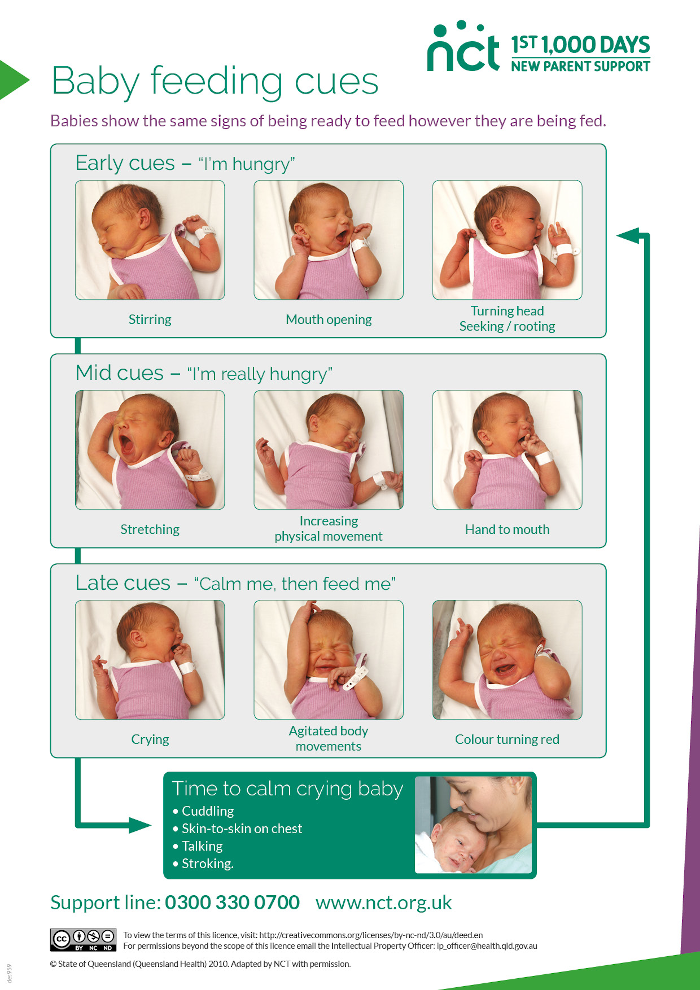
How long should each feed last?
Every baby is unlike and they will go through different patterns of feeding as they grow (Kent et al, 2012). How much milk a babe needs per breastfeeding session volition vary. Information technology's best to exist guided past your kid (Kent et al, 2012).
Some feeds will seem to last a long time, with your baby dozing for brusque periods earlier wanting more. And more than. And still more than! Information technology's normal for a young infant to be on the breast many times a twenty-four hours and nighttime. 12-xv 'visits' to the breast is well within a normal range (Entwistle, 2013).
Equally a general rule, babies who are feeding well volition feed for betwixt v and twoscore minutes at each feed (UNICEF, 2010). Your baby will let you lot know when they've had plenty milk. They will usually come off the breast themselves, look sleepy or calm, and look around (UNICEF, 2010).
During each breastfeed, your milk changes slightly. So the milk at the end of the feed is more creamy and filling than the milk at the beginning of the feed (Ballard and Morrow, 2013). Offer i breast and let your baby feed until they terminate drinking. If they still appear hungry, offering the second breast – allowing them to drink equally much as they desire (Overnice, 2015).
Should I wake my infant up to feed?
In about cases, salubrious, thriving newborns will wake up for feeds and, provided they are well latched on, become all the milk they need (Australian Breastfeeding Clan, 2017). But in that location might exist reasons why a newborn might be more sleepy and therefore need to be woken up for feeds.
This includes medical reasons, such as jaundice, infection or a eye trouble, or possibly because the pain relief used during birth is however affecting them (Australian Breastfeeding Clan, 2017). If you're worried your baby might exist sleeping as well much and this is affecting their feeding, talk to your health visitor or call our Babe Feeding Support line on 0300 330 0700.
This page was last reviewed in March 2021
Further information
Nosotros support all parents, nevertheless they feed their child. If you have questions, concerns or need support, you can speak to a breastfeeding counsellor by calling our helpline on 0300 330 0700, whether y'all are exclusively breastfeeding or using formula milk. Breastfeeding counsellors have had all-encompassing training, will listen without judging or criticising and will offer relevant information and suggestions. You lot can besides find more useful articles here.
National Breastfeeding Line (government funded): 0300 100 0212.
References
Australian Breastfeeding Association. (2017) Do I need to wake my baby for feeds? Available at: https://www.breastfeeding.asn.au/bfinfo/practice-i-need-wake-my-infant-feeds [Accessed 20 March 2021].
Ballard O, Morrow AL. (2013) Man milk limerick: nutrients and bioactive factors. Pediatric Clinics of Northward America. 60(1):49-74. Available at: https://world wide web.ncbi.nlm.nih.gov/pmc/articles/PMC3586783/ [Accessed xx March 2021].
Crenshaw J. Care practice #6: No separation of mother and baby, with unlimited opportunities for breastfeeding. Journal of Perinatal Education2007;16(3):39-43. Available at: doi: 10.1624/105812407X217147 (Accessed 26 Apr 21)
Daly SEJ, Hartmann PE (1995). Infant Demand and Milk Supply. Part 1: Babe Need and Milk Production in Lactating Women. Journal of Human Lactation. 11(1):21-26. doi:10.1177/089033449501100119 Available at https://journals.sagepub.com/doi/10.1177/089033449501100119 [Accessed 13 April 2021]
Entwistle FM. (2013) The evidence and rationale for the UNICEF Great britain Infant Friendly Initiative standards. UNICEF Great britain. Available at: https://world wide web.unicef.org.united kingdom of great britain and northern ireland/babyfriendly/about/testify-and-rationale-for-the-infant-friendly-standards/ [Accessed 20 March 2021].
Fallon A, Van der Putten D, Dring C, Moylett EH, Fealy G, Devane D. (2016) Baby-led compared with scheduled (or mixed) breastfeeding for successful breastfeeding. Cochrane Database of Systematic Reviews. (9):CD009067. Available at: http://onlinelibrary.wiley.com/doi/ten.1002/14651858.CD009067.pub3/total [Accessed 20 March 2021].
Kent JC, Prime DK, Garbin CP. (2012) Principles for maintaining or increasing chest milk production. Journal of Obstetric, Gynecologic, and Neonatal Nursing. 41(1):114-121. Available at: https://onlinelibrary.wiley.com/doi/full/10.1111/j.1552-6909.2011.01313.x [Accessed 20 March 2021].
Leurer Doc, Misskey Eastward. (2015) "Be positive too as realistic": a qualitative description assay of information gaps experienced by breastfeeding mothers. International Breastfeeding Journal. 10(10):two-eleven. Available at: https://internationalbreastfeedingjournal.biomedcentral.com/articles/10.1186/s13006-015-0036-7 [Accessed 20th March 2021].
NHS. (2019a) Breastfeeding: the get-go few days. Available at: http://www.nhs.uk/Conditions/pregnancy-and-baby/Pages/breastfeeding-beginning-days.aspx#building [Accessed twenty March 2021].
NHS. (2019b) Breastfeeding: is my baby getting plenty milk? Available at: http://www.nhs.uk/Conditions/pregnancy-and-baby/Pages/breastfeeding-is-infant-getting-enough-milk.aspx [Accessed twenty March 2021].
NHS. (2020) Your breastfeeding questions answered. Bachelor at: http://world wide web.nhs.united kingdom of great britain and northern ireland/Conditions/pregnancy-and-baby/Pages/your-breastfeeding-questions.aspx [Accessed 20 March 2021].
NICE (2015) Postnatal care upwardly to 8 weeks after nascence. CG37. Bachelor at: https://www.nice.org.uk/guidance/cg37 [Accessed 20 March 2021].
UNICEF. (2010) Baby Friendly Initiative. Breastfeeding checklist for mothers - How can I tell that breastfeeding is going well? Available at: https://world wide web.unicef.org.uk/babyfriendly/wp-content/uploads/sites/ii/2016/ten/mothers_breastfeeding_checklist.pdf [Accessed twenty March 2021].
World Health Organisation. (1998) Show for the 10 Steps to Successful Breastfeeding. Geneva: Globe Health Organization.
Earth Health Organization. (2009) Session 2 The physiological basis of breastfeeding. In: Infant and Young Kid Feeding. Model Chapter for Textbooks for Medical Students and Centrolineal Wellness Professionals. Available at: https://www.ncbi.nlm.nih.gov/books/NBK148970/ [Accessed 20th March 2021].
Further reading
Hoddinott P, Craig, LCA, Britten J, McInnes RJ. (2012) A serial qualitative interview study of infant feeding experiences: idealism meets realism. BMJ Open ii:1-14. Available at: https://bmjopen.bmj.com/content/2/2/e000504 [Accessed twenty March 2021].
Martin CR, Ling PR, Blackburn GL. (2016) Review of infant feeding: key features of chest milk and infant formula. Nutrients, 8(v):279. Available at: https://world wide web.mdpi.com/2072-6643/8/5/279 [Accessed 20th March 2021].
Source: https://www.nct.org.uk/baby-toddler/feeding/early-days/how-often-should-i-breastfeed-my-baby
0 Response to "How Often Should I Breastfeed My 6 Day Old Baby"
Enviar um comentário